
Waste season tickets: the rules, the schedule and renewing
In short: when the same non-hazardous waste moves regularly between the same people, one signed transfer note, a season ticket, can cover every load for up to a year. You still keep a schedule of each load's date, time and quantity, keep both for 2 years after the last load, and agree a new one when the year is up or the parties or waste change.
What a season ticket is
Normally every load of waste that changes hands needs its own transfer note. GOV.UK says that for each load of non-hazardous waste you move off your premises, you need a waste transfer note or a document with the same information.
A season ticket is the exception for regular, repeated loads. In England you can use a season ticket to cover multiple transfers of non-hazardous waste over a period of up to a year. It is sometimes called an annual waste transfer note. It carries the same details as any transfer note (see our transfer notes guide), signed once by both sides, plus a schedule of the loads it covers.
When you can use one
- The same parties and the same waste. In England the current holder, the carrier and the type of waste must stay the same. If any of them change, you need a new season ticket or a single note.
- Up to a year. The ticket covers a period of up to a year, then needs renewing.
- Non-hazardous waste only. Hazardous waste moves on consignment notes instead: you must use consignment notes to move hazardous waste.
The schedule of loads
A season ticket doesn't remove the record of each load. GOV.UK says to keep a separate schedule listing the date, time and quantity of each transfer, and the site if it varies, and that you can record these details on a spreadsheet, or as part of your invoicing or weighbridge records.
The ticket and its schedule belong together: the ticket says what the waste is and who is involved, and the schedule says when each load moved and how much.
Keeping it, and showing an officer
You must keep your season ticket and schedule for 2 years after the last waste transfer. For a ticket renewed every year, that means each year's ticket is kept for two years after its own last load.
In England and Wales the law also says both parties must produce it to an officer of the appropriate body or of a waste collection authority on demand within 7 days. Keep the ticket and its schedule where you can put them together quickly.
Signing it electronically
Paper isn't required. A transfer note may be in electronic form if the person producing it can do so in a visible and legible documentary form, with an electronic signature, and the code of practice says the signature can be electronic as long as an enforcement officer can view it.
Whatever you use, keep what was signed, who signed it and when, so you can show an officer the agreed description.
Changes part-way through, and renewing
Because the holder, carrier and type of waste must stay the same, a change to any of them part-way through the year can't simply be written onto the existing ticket. You need a new season ticket, or a single note for the load, agreed by both sides.
When the year is up the ticket ends. A new one is agreed and signed for the next period: it's a good moment to check the description, the EWC code, the container and the parties are still right.
Season tickets and digital waste tracking
Digital waste tracking records each load separately, so it doesn't use season tickets. It isn't a replacement for transfer notes yet either: the Environment Agency says operators must also continue to complete hazardous waste consignee returns, quarterly waste returns, consignment notes and waste transfer notes as normal. See our digital waste tracking guide for who reports what, and when.
Wales, Scotland and Northern Ireland
Wales
Wales follows the same law and code of practice as England: the code applies to waste in England or Wales, and Natural Resources Wales enforces the waste duty of care there.
Scotland
Scotland's code allows a season ticket for waste of the same description transferred between the same transferor and transferee for up to 12 months, with a log of each load.
Northern Ireland
A season ticket can be used where the same waste goes from the same place, using the same company, to the same waste management site, for up to 12 months, with a log of each transfer.
Checklist
- Is the waste non-hazardous? Hazardous waste needs a consignment note for every load.
- Will the holder, the carrier and the type of waste stay the same for the whole period?
- Does the ticket carry everything a transfer note needs, and is it signed by both sides?
- Is it for a year or less, with the end date written on it?
- Is every load on the schedule, with its date, time and quantity?
- If something changed part-way through, was a new ticket or a single note agreed?
- Can you find the ticket and its schedule quickly, for 2 years after the last load?
Common questions
How long does a waste season ticket last?
Up to a year. In England a season ticket can cover multiple transfers of non-hazardous waste over a period of up to a year. Scotland and Northern Ireland allow up to 12 months. After that you need a new one.
What has to stay the same on a season ticket?
In England the current holder, the carrier and the type of waste must stay the same. If any of them change, you need a new season ticket or a single transfer note.
Do you still record each load on a season ticket?
Yes. You keep a schedule of the date, time and quantity of each transfer, and the site if it varies. It can be a spreadsheet, or part of your invoicing or weighbridge records.
How long do you keep a season ticket?
GOV.UK says you must keep your season ticket and schedule for 2 years after the last waste transfer, and in England and Wales the law says you must produce it to an officer on demand within 7 days.
Can a season ticket be signed electronically?
Yes. In England and Wales a transfer note may be in electronic form with an electronic signature, and the code of practice says the signature can be electronic as long as an enforcement officer can view it.
Can hazardous waste go on a season ticket?
No. Hazardous waste moves on consignment notes: in England you must use consignment notes to move hazardous waste.
Check the official guidance
This guide is based on these pages. Rules change, so check them for the latest position.
- Dispose of business or commercial waste: Waste transfer notes (GOV.UK)
- Waste duty of care: code of practice (GOV.UK, Defra and Environment Agency)
- The Waste (England and Wales) Regulations 2011, regulation 35 (legislation.gov.uk)
- Hazardous waste: Consignment notes (GOV.UK)
- Digital Waste Tracking goes live: a major step forward in stopping waste crime (Environment Agency blog, GOV.UK)
- Waste duty of care (Natural Resources Wales)
- Managing controlled waste - duty of care: code of practice, 2. Your Obligations as a Waste Producer (Scottish Government)
- Duty of care when transferring your business waste (nibusinessinfo.co.uk, Northern Ireland)
How Tippa helps
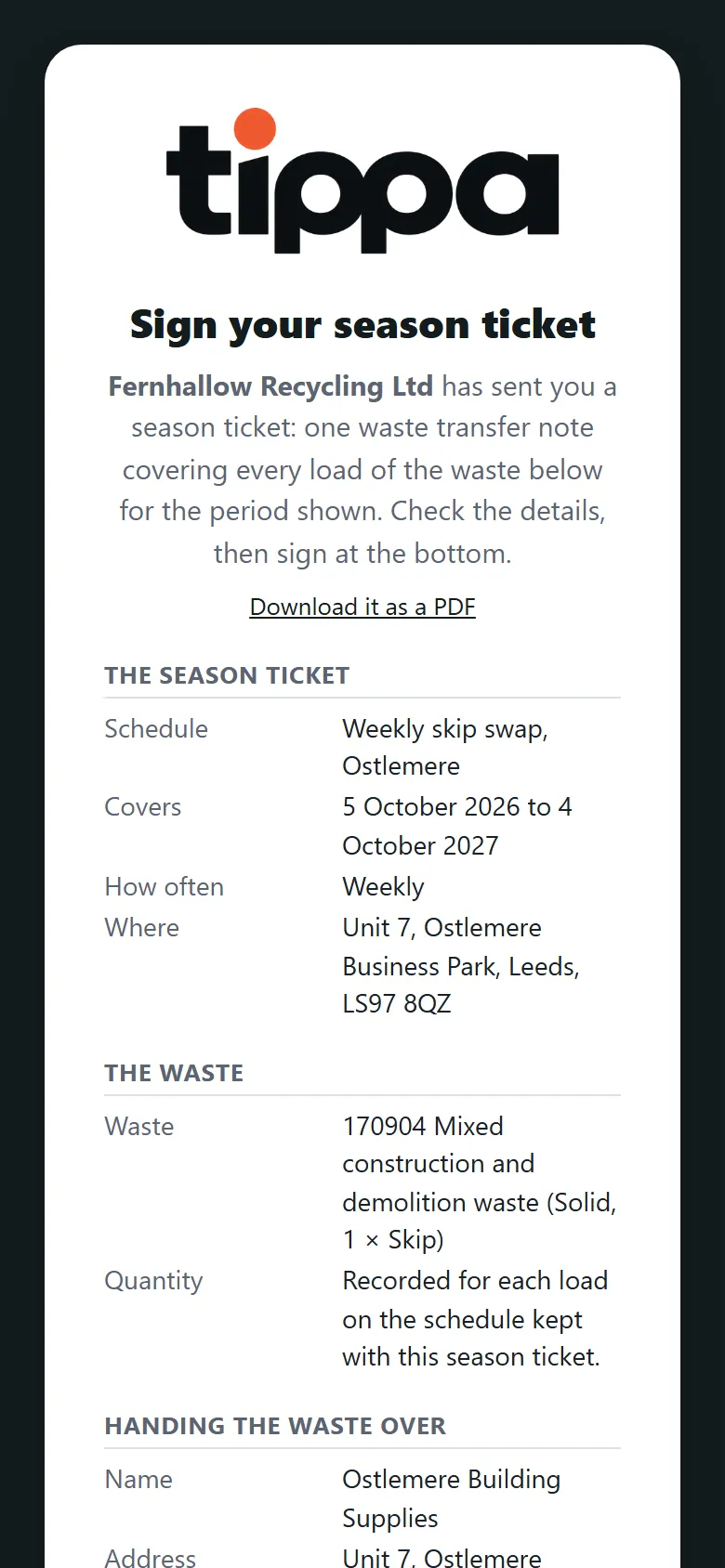
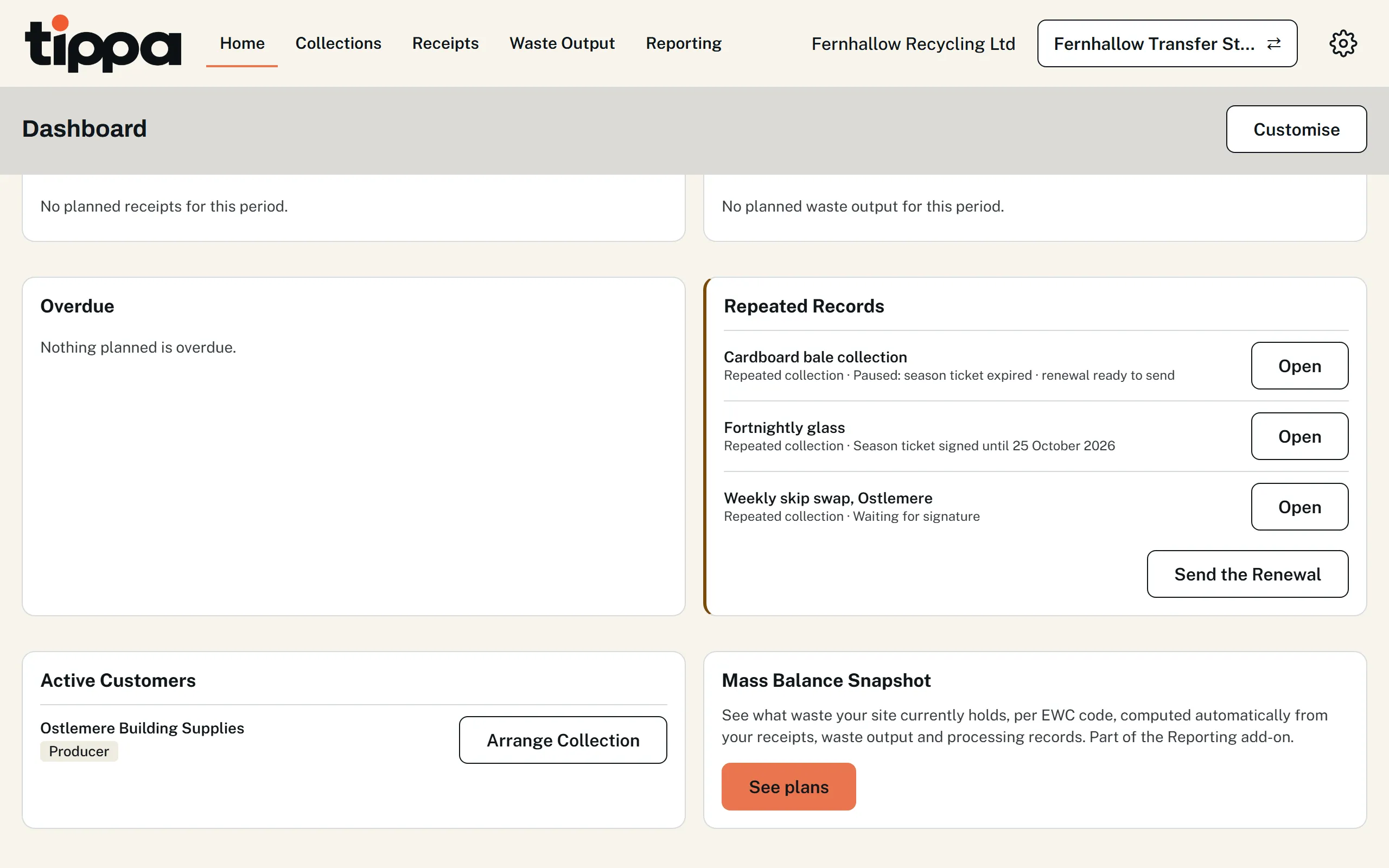
In Tippa a season ticket belongs to a repeated receipt, movement or collection: set the regular load up once, and every load it covers is its own record, which is the schedule.
- Your customer gets a one-time link to check the season ticket and sign it online, or you upload a copy signed on paper. Nothing is created until it's signed.
- Bring paper season tickets you already have: Tippa reads one to fill the form in and keeps it as the signed copy. With the Note Uploads add-on, £10 + VAT a month
- Each load is created for you 4 weeks ahead and keeps its own date, time and quantity.
- Download the signed season ticket with its schedule of loads, as a PDF or a spreadsheet, ready to show an officer.
- A change to who or what it covers goes to your customer to accept, while the signed one carries on.
- The renewal is drafted 30 days before the year is up for you to check and send (all at once, if you like), your customer is reminded each week, and your office is told on the dashboard and by email.
Repeated Records add-on, £20 + VAT a month
This guide is general information about UK waste rules, not legal or regulatory advice. You remain responsible for meeting the duties that apply to your business; check the official guidance above and take professional advice where you need it.