Every hazardous load on its note, every return sent for you
A consignment note for every load, a return to your regulator and one to each producer. Tippa makes them all from the loads you book in.
- Consignment notes filled in, free. On each nation’s form, hazardous properties and POPs included, with your part done as you book the load in.
- Accept, reject or quarantine. Item by item, with the producer told when waste is turned away.
- Returns built and sent. Consignee and producer returns, or copies to SEPA and NIEA, with Consignee Returns at £20 + VAT a month.
A typical site taking hazardous waste, with 1 site, 2 office users, Consignee Returns and Waste Returns: £50 + VAT a month. How it adds up
What a typical site taking hazardous waste pays.
One permitted site taking hazardous loads alongside the rest, with two people in the office, sending its consignee return, its returns to producers and its waste return.
- Extra office users, 1 × £5£5
- Waste Returns£25
- Consignee Returns£20
£50 + VAT a month
1 site and 1 office user come free, and so do consignment notes, quarantine and reporting every load to Defra.
Every add-on starts with a free month, with no card needed. Work out your own price
Tested against Defra’s own checks.
Each hazardous load goes to Defra with its consignment code, hazardous properties, components and POPs. Defra publishes test scenarios for software that reports received waste, hazardous and POPs waste among them. Tippa supports all 14, with none exempted: it passed every one Defra’s service checks, and refused a hazardous load with no consignment code or reason, as it should. Tippa is on GOV.UK’s list of compatible software providers.
What Tippa does for you.
Each hazardous or POPs load, against its note
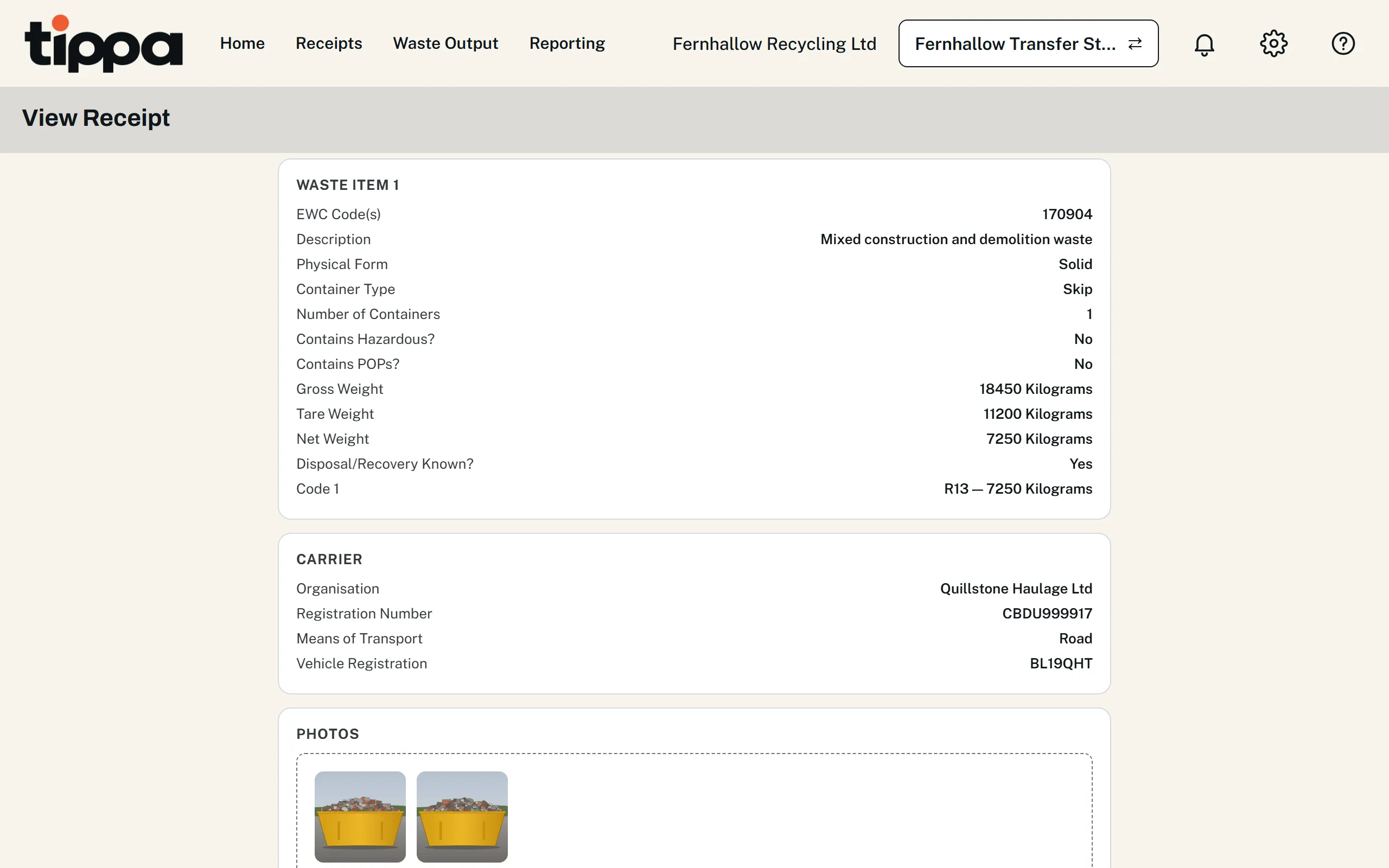
Record the consignment note code with the load, and Tippa warns you when it isn't in the shape the EA, NRW, SEPA or NIEA use. Picking a hazardous EWC code asks for its hazardous property codes, and each item keeps its chemical components and their concentrations (more than or less than a figure, as Defra allows). Contains POPs records persistent organic pollutants the same way: each POP picked from Defra’s own list, with its concentration and where the figure came from, for POPs waste under any code, such as sofas under 20 03 07. Read the guide to POPs waste. Each receipt says who produced the waste and where it was collected from: taken from your own collection, from the consignment note, or picked on the receipt. A load that arrives with no note is flagged, as it should have been refused.
The consignment note, filled in for you
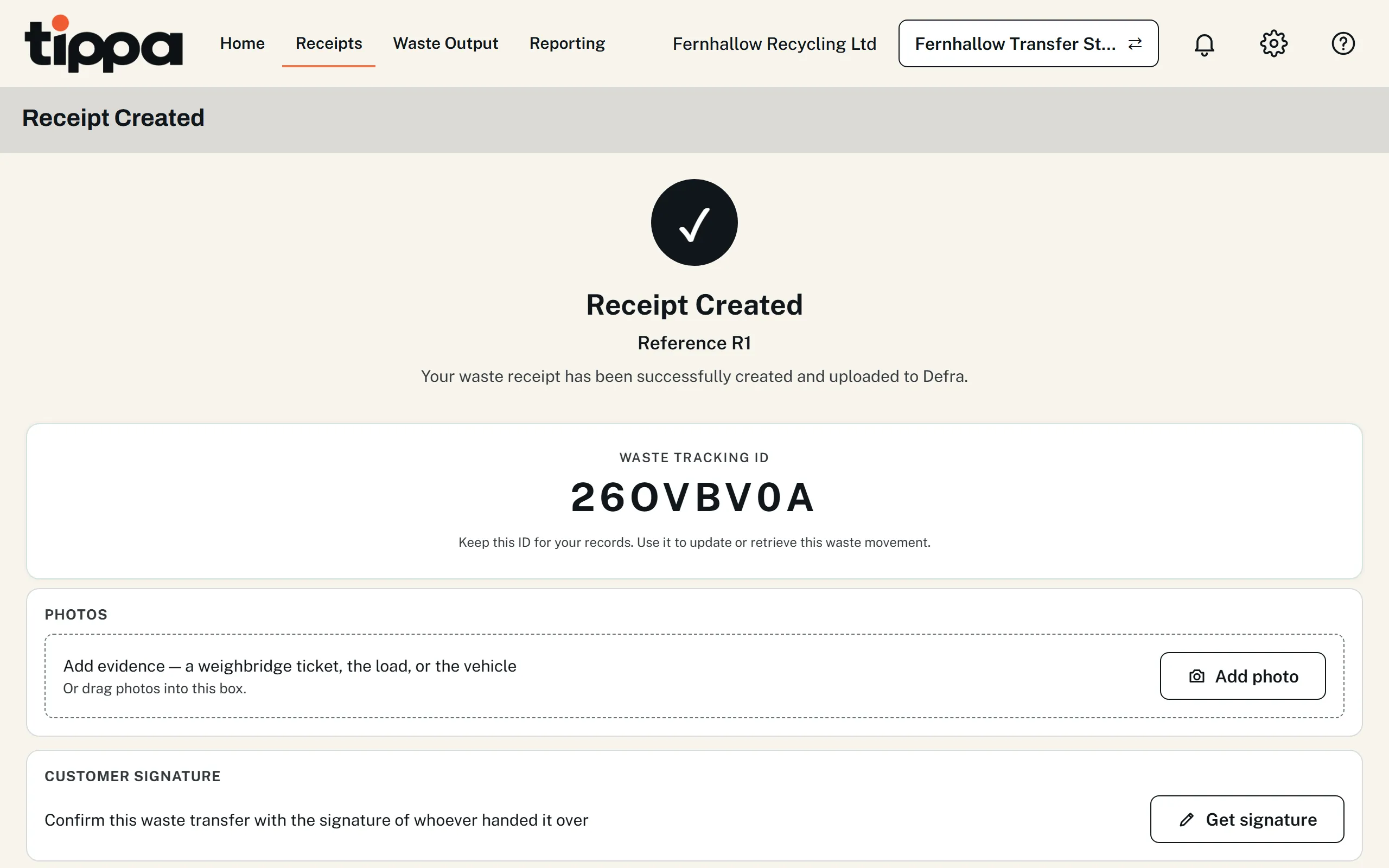
Each hazardous receipt, load going out and collection gets its consignment note filled in from the record, to print, download or email: the Environment Agency's form for waste moved from England, Natural Resources Wales's from Wales, SEPA's from Scotland (left fillable, as SEPA's PDF is) and NIEA's from Northern Ireland, with all its copies. The code, the producer and the process giving rise to the waste, each waste with its hazardous properties, POPs, components and UN details, the carrier and the signatures go in from what you've recorded, and Part E once you've booked the load in, with what you accepted, what you turned away and why. Waste that doesn't fit goes on the form's own continuation or additional sheets. Free.
Accept, reject or quarantine
Decide item by item. Quarantine waste on site with a deadline worked out in working days, and the dashboard lists it until it's resolved. Rejected waste is kept with its reason and where it went, and the producer is emailed when their hazardous waste is turned away. Waste turned away from one of your own vans goes back on it, and the office is alerted to send it elsewhere or back to its producer.
The consignment note read for you
Fill a receipt in from the Environment Agency's consignment note, a company's own note or a photo of a handwritten one, instead of typing it: the code, where it was collected from, the producer, each waste line and its hazards. Every value is checked against the note, and the photos stay with the receipt as evidence. Note Uploads add-on
Your consignee return, built and sent
Your EA or NRW hazardous waste consignee return, made from the hazardous loads you've received, rejected ones included, and emailed to the regulator for you, with a null return for a quiet quarter. Each permit gets its own. Scottish and Northern Irish codes are converted to the format the EA and NRW want, multiple collections are grouped by their round number, and anything that would hold the return up is listed with the fix beside it before anything is sent. If a load changes after the return has gone, Tippa says so, so you can send a correction. Read the guide. Consignee Returns add-on
Copies to SEPA and NIEA as loads arrive
SEPA and NIEA want a copy of each consignment note rather than a quarterly return. At a site in Scotland or Northern Ireland, or for Scottish or Northern Irish waste you receive in England or Wales, Tippa emails each one to them as the load is booked in, on SEPA's own form and as NIEA's deposit copy, with the photos of the note. Read the guide to special waste in Scotland. Consignee Returns add-on
Returns to producers
In England and Wales, each producer's quarterly return of the hazardous waste you accepted from it is made on the official form and emailed to them for you, one at a time or all at once. Your dashboard says which producers are still waiting for theirs, and which returns each site owes for the quarter just ended, free. Consignee Returns add-on
Reported to Defra as you receive
Each load goes to Defra's Digital Waste Tracking service when you receive it, with its consignment code, hazardous property codes, components and POPs; change a receipt and the change is sent too. If Defra doesn't accept one you see why straight away, and Tippa keeps trying every hour while Defra's service is down. Tippa doesn't charge for this. Read the guide.
Every permit, and what's on site
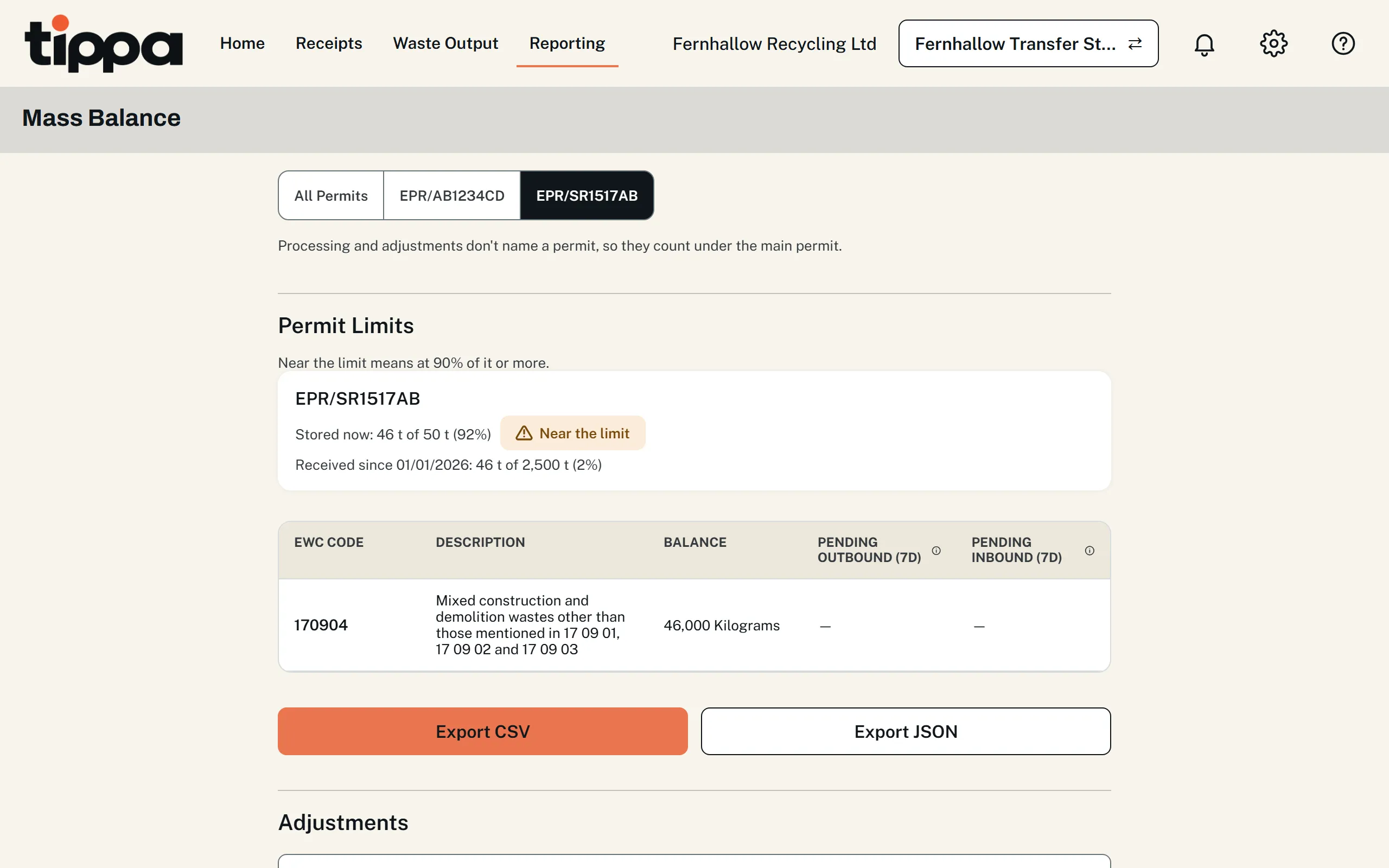
Add each permit your site holds and Tippa checks it on its regulator's register and fills in the waste codes, limits and operations it allows. Each load is received under the permit that allows its waste, and hazardous waste can be moved between your own permits with no consignment note, since it never leaves the site. Mass Balance shows what should still be on site for each permit against its storage and yearly limits, and shares dual-coded waste such as clinical waste between its codes as you set. Mass Balance: Reporting add-on
Collecting it yourself
If your own vehicles collect hazardous waste, each collection keeps its consignment code and reaches your site as its own planned receipt, never mixed with other waste. Its consignment note is filled in as it's collected, and the driver opens it on their phone to print, as the note travels with the waste, on paper. A round collecting from several premises in England and Wales puts its hazardous round number on each note, and in Scotland or Northern Ireland it can go on one note as a carrier's round, filled in for every stop, with its carrier's schedule after it. Rounds: Round Planning add-on
What it costs.
Start free, and pay only for what you add, once its free month is up. Prices are per month, plus VAT.
- 1 site and 1 office user
- Hazardous receipts, quarantine and rejections
- Consignment notes filled in, in every nation
- Reporting every load to Defra
- Carrier and permit register checks
- Moves between your permits
- Photos, signatures and a full history
- A dashboard of what needs doing, with return reminders
- Consignee Returns (consignee return, SEPA and NIEA copies, returns to producers): £20
- Waste Returns: £25
- Note Uploads (fill a receipt from a consignment note): £10
- Reporting (reports, exports, Mass Balance): £15
- Extra sites: £25 each, up to 200
- Extra office users: £5 each
Guides for you.
The rules that apply to your work, in plain English, with links to the official guidance.
Choosing software? Transfer station software compared sets the main products side by side, Tippa included.
Consignee returns
What sites receiving hazardous waste must report, and by when.
Special waste in Scotland
SEPA's consignment notes, and the copy the receiving site sends.
Digital waste tracking
What receiving sites must report to Defra, and how to get set up.
EWC codes explained
How the List of Wastes works, hazardous and mirror entries included.
D and R codes explained
Disposal and recovery codes, and where you need them.
POPs waste
Which waste contains POPs, whether it’s hazardous, and what must happen to it.