
Permit tonnage limits: yearly and storage limits, and staying within them
In short: most waste permits limit how much waste you can accept in a year, how much you can store at any one time and how long it can stay. The Environment Agency's guidance says you must not accept waste if you would breach your permit by doing so, and that your records should show the waste on site against your permit's limits. Breaking a permit condition is an offence, and it counts against your compliance score.
The kinds of limit a permit sets
- A yearly limit on the waste you accept. The EA's transfer station rules, for example, say no more than 75,000 tonnes of waste shall be accepted per year. It counts what comes in, not what's left on site.
- A storage limit: the most waste on site at any one time. The same rules allow 15,000 tonnes of one group of wastes and 40,000 tonnes of another at any one time.
- A time limit on how long waste is stored, such as 6 months at a transfer station.
- Smaller limits inside those for particular wastes or activities. The transfer station rules cap hazardous waste at 50 tonnes and waste batteries at 10 tonnes, and the recycling rules allow no more than 50 tonnes a day to be treated for disposal.
Limits in some common standard rules permits
A standard rules permit uses a fixed set of rules, and you cannot change them. These are the limits in some sets small sites often hold in England. Your permit names the set it's on: check that set's own rules.
| Set | Accepted a year | Stored at any one time | Longest storage |
|---|---|---|---|
| SR2022 No 5: non-hazardous waste transfer | No more than 75,000 tonnes | 15,000 tonnes (Table 2.3a wastes) and 40,000 tonnes (Table 2.3b) | 6 months |
| SR2022 No 4: non-hazardous waste recycling | Less than 75,000 tonnes | 15,000 tonnes (Table 2.3a wastes and what's made from them) and 40,000 tonnes (Table 2.3b) | 6 months |
| SR2022 No 3: construction, demolition and excavation waste transfer | No more than 250,000 tonnes | 50,000 tonnes in total | 12 months |
| SR2021 No 11: small metal recycling | No more than 5,000 tonnes | 100 tonnes | 3 years |
| SR2015 No 16: metal recycling | Less than 25,000 tonnes | See the set | See the set |
| SR2021 No 12: vehicle depollution and dismantling | Less than 750 tonnes | See the set | 1 year before disposal, 3 years before recovery |
Older permits may still name a set GOV.UK has since withdrawn. The SR2008 No 1 and SR2008 No 3 transfer station sets were withdrawn on 30 June 2025 and consolidated into SR2022 No 5 and SR2022 No 4. The full list of sets is on GOV.UK's standard rules collection.
Bespoke permits
A bespoke permit is tailored to your business activities, so its limits are your own. The application asks for your annual throughput in tonnes each year and your total storage capacity, meaning the most waste in tonnes stored on the site at any one time. Read your permit for the figures it settled on.
Keeping track of where you stand
The EA's appropriate measures for non-hazardous and inert waste sites set out what your records should do:
- Weigh each load of waste on arrival.
- Run a tracking system that works as a waste inventory and stock control system, reporting the quantity of waste on site, and how long it has been there, against the limits in your permit.
- Regularly monitor the waste stored against the allowed maximum capacities, and not exceed them.
- Don't accept a load if the capacity isn't available, or if you would breach your permit by accepting it.
In practice that means two running totals. For the storage limit: what came in, less what went out, is what should be on site now. For the yearly limit: the total accepted so far this year, whatever has since left. Check how your permit counts its year.
Fire prevention adds its own limits for combustible waste. The EA's fire prevention plan guidance says such waste must be stored for less than 6 months, with piles no more than 4m high and 20m long or wide. If you keep piles at their largest size for longer than 3 months, you must show what extra measures prevent them catching fire on their own.
How the regulator checks
- Your waste returns. Under the standard rules, within one month of each quarter's end you send the EA the waste accepted and removed in that quarter; some sets, such as small metal recycling, ask for it yearly. The EA says it uses returns to monitor compliance with environmental permit conditions. More in our guide to waste tonnage returns.
- Your records. The standard rules ask you to keep records for at least 6 years from when they were made, unless the EA agrees otherwise in writing.
- The compliance score. The EA scores each breach of a permit condition by its risk: 60, 31, 4 or 0.1 points. A year's total sets the site's band, from A (no points) to F (more than 150), and the band sets the yearly subsistence charge, from 95% of the standard charge in band A to 300% in band F. Sites in bands E and F are more likely to have their permit revoked.
- Enforcement. The EA's first response is usually advice and guidance or a warning, and prosecution is generally a last resort. Breaching a permit condition is still an offence.
If you're getting close to a limit
- Stop taking waste you have no room for. The EA's guidance is clear that you must not accept waste if doing so would breach your permit.
- Move waste on to bring the storage figure down. Moving waste off site doesn't reduce the yearly total, which counts what you've accepted.
- Apply to change your permit if the business has outgrown it. You can apply to change your permitted activity or its conditions. A standard rules permit can only have an administrative or minor variation. GOV.UK gives changing your annual throughput, with no more storage and no more risk, as an example of a minor variation. If you won't meet the standard rules any more, you need a bespoke permit instead, which is likely to be a substantial variation.
GOV.UK publishes no fixed time for a decision: it depends on the application. Apply well before you reach the limit, not after.
Wales, Scotland and Northern Ireland
- Wales: Natural Resources Wales has its own standard rules sets. Its SR2008 No 1 transfer station set, for example, keeps the limit of less than 75,000 tonnes a year.
- Scotland: since 1 November 2025, waste activities are regulated under the Environmental Authorisations (Scotland) Regulations 2018. Depending on the activity, you need a permit or a registration, or must follow general binding rules. Your authorisation sets its own conditions.
- Northern Ireland: NIEA sets the conditions in each waste management licence and monitors sites against them. A modification isn't needed if the existing conditions aren't exceeded. NI's waste summary returns run in quarters from April, so its first quarter is 1 April to 30 June.
Common questions
Does the yearly limit count waste I've already sent on?
Yes. The yearly limit counts the waste you accept: the EA's transfer station rules say no more than 75,000 tonnes of waste shall be accepted per year. Sending waste on frees up storage, not the yearly total.
What happens if I go over a limit?
Breaching a permit condition is an offence. The EA scores the breach, which can raise your subsistence charge, and its first response is usually advice or a warning.
Can I raise my permit's limit?
You can apply to vary your permit. On a standard rules permit, changing the annual throughput with no more storage or risk can be a minor variation; going beyond the set's rules means a bespoke permit.
Do I have to keep a running total?
The EA's appropriate measures say your tracking system should work as a waste inventory and stock control system, reporting the waste on site against your permit's limits.
Check the official guidance
This guide is based on these pages. Rules change, so check them for the latest position.
- SR2022 No 5: non-hazardous waste transfer (GOV.UK / EA)
- SR2022 No 4: non-hazardous waste recycling (GOV.UK / EA)
- SR2022 No 3: construction, demolition and excavation waste transfer station (GOV.UK / EA)
- SR2021 No 11: small metal recycling facility (GOV.UK / EA)
- SR2015 No 16: metal recycling site (GOV.UK / EA)
- SR2021 No 12: vehicle storage, depollution and dismantling (GOV.UK / EA)
- Standard rules: environmental permitting (GOV.UK / EA)
- Waste: environmental permits (GOV.UK / EA)
- Application for a bespoke waste operation permit, part B4 (EA)
- Non-hazardous and inert waste appropriate measures: waste acceptance and tracking and waste storage (GOV.UK / EA)
- Fire prevention plans: environmental permits (GOV.UK / EA)
- Waste returns (GOV.UK / EA)
- Assessing and scoring environmental permit compliance (GOV.UK / EA)
- Environment Agency enforcement and sanctions policy (GOV.UK / EA)
- The Environmental Permitting (England and Wales) Regulations 2016, regulation 38 (legislation.gov.uk)
- Change, transfer or cancel your environmental permit (GOV.UK / EA)
- Environmental permitting charges guidance (GOV.UK / EA)
- Standard rules and risk assessments for waste (NRW)
- How we regulate (SEPA)
- Waste management licence guidance (DAERA)
- Waste summary returns form and guidance (DAERA)
How Tippa helps
Tippa keeps the running totals for you, from the loads you already record.
- Add each permit your site holds and Tippa checks it on its regulator's register, then fills in its waste codes, tonnage limits and operations from its standard rules set or its published permit. You can change any of it. Free.
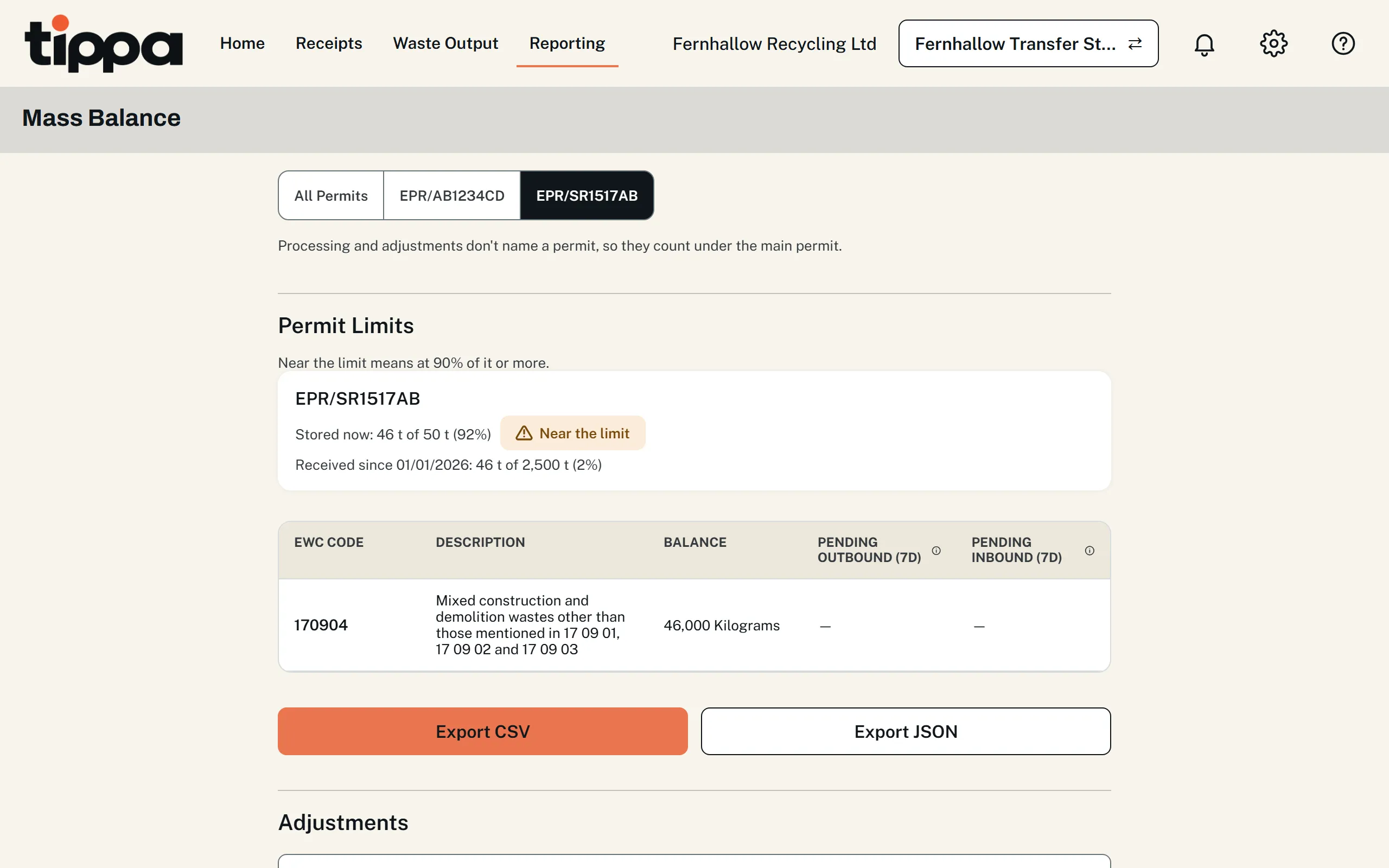
- Mass Balance, in the Reporting add-on, shows what should be on site from what came in and went out, for the whole site or each permit, with each permit's storage and yearly limits and how close you are: “Near the limit” from 90%, “Over the limit” once past it. It shows where you stand; it doesn't stop a load being saved.
- Your tonnes in and out, day by day, on the dashboard, free.
- The same records build your regulator's waste returns, with the Waste Returns add-on.
- Checking someone else's site? The free permit checker looks a permit up on the public registers, no account needed.
This guide is general information about UK waste rules, not legal or regulatory advice. You remain responsible for meeting the duties that apply to your business; check the official guidance above and take professional advice where you need it.